
Mining as a Side Operation: What a Small Business Should Model
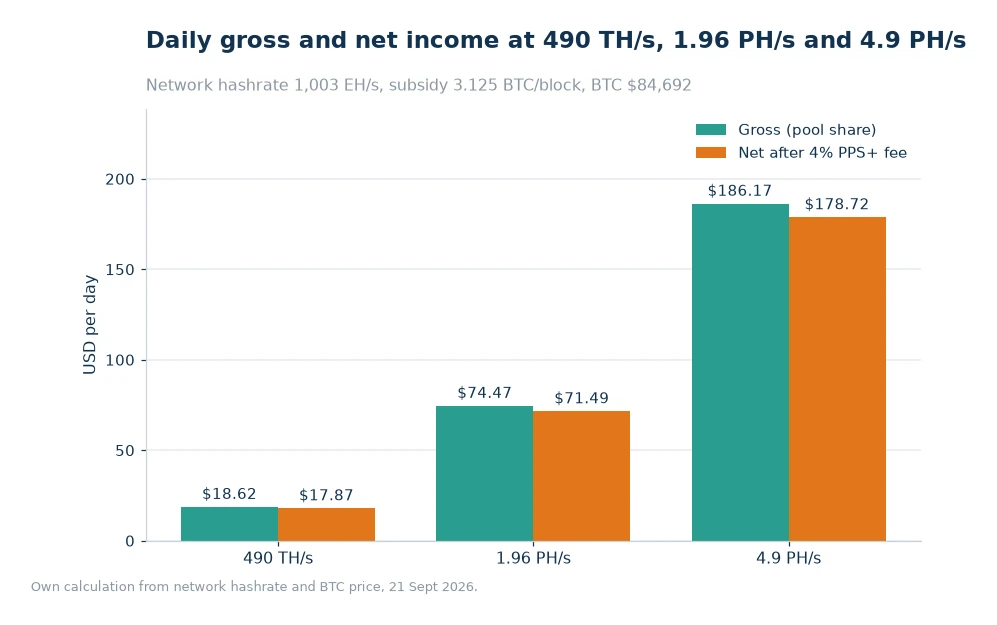
A small business already has what a mining setup needs most: a building, a power connection and someone who notices when something is wrong. A 490 TH/s machine adds 0.00021982 BTC a day, about $18.62 gross and $17.87 after the listed 4% on the block-reward component. The question is whether that belongs on the profit and loss sheet or in a separate experiment.
Key takeaways
- At 490 TH/s the daily net is $17.87 at BTC $84,692, or about $500 over a four-week month.
- A quarter of continuous operation is worth roughly $1,626 at that rate, which is the right scale for judging a lease or a repair.
- Separate the mining wallet from the operating account so the side activity can be read on its own.
- Check the lease and insurance terms before the first machine goes on the shelf.
Mining beside a business, not instead of one
The appeal of a side operation is that it uses capacity the business already pays for: a back room, an unused circuit, a broadband line that is already installed. That is a genuine advantage, and it is also the source of the most common mistake, which is treating shared costs as free. The room has a rent value, the circuit has a capacity limit, and the person who checks the machine has an hourly cost even when no invoice is raised.
A simple rule keeps the experiment honest. Charge the mining activity for the power it uses, a share of the space, and a realistic number of staff minutes. If it still shows a surplus, the business has learned something useful. If it only works when those costs are ignored, the surplus is an accounting artefact and will disappear the first time the space is needed for something else.
Cash flow timing for a small operator
Mining income arrives in small amounts continuously, while business costs arrive in larger amounts on fixed dates. That mismatch is manageable but worth planning. A machine that credits the account every hour can smooth a quiet week, but it will not cover a quarterly insurance bill on its own. Treat the credits as a slow trickle and keep the operating buffer separate.
The ViaBTC Crypto Mining account shows the credit history in the same place as the wallet, which makes it easy to move a month's proceeds into the business account on a fixed date. A fixed transfer date is better than ad hoc withdrawals, because it produces a clean monthly figure and stops the mining balance from being spent twice.
Space, noise and the lease clause
A commercial lease often restricts what can be installed, how much power can be drawn and what noise is acceptable. A miner is a noisy electrical appliance that runs continuously, and a landlord or neighbouring tenant may object even if the machine is small. Read the lease before ordering hardware, and if the space is shared, speak to the neighbour first. A conversation costs nothing; a dispute can cost the tenancy.
Insurance is the other document to check. Standard business cover may not include mining hardware, and a rider is usually cheaper than discovering the gap after a failure. Photograph the installation, keep the serial numbers and note the firmware version. Those details make a claim straightforward and also help if the equipment is ever stolen.
Separating the wallet from the till
Commingling is the bookkeeping sin of a side operation. If mining coins land in the same wallet as customer payments, the accountant cannot separate trading income from mining income, and a tax review becomes a reconstruction exercise. Use a dedicated wallet, label it clearly, and transfer to the operating account on a schedule.
If the business needs liquidity and holds coins, a secured facility can be a better route than selling at an inconvenient moment. Collateral-Pledged Loans are designed for exactly this situation, with a process that runs from adding collateral through to redeeming it. That is a financing decision, not a mining one, and it should be made with the same care as any other borrowing.
When the side operation should pause
A side operation should pause when it stops covering its variable cost, not when it stops being exciting. Power and maintenance are the variable costs; the machine is already bought. If the daily net falls below the daily power bill for a sustained period, running the machine converts electricity into a smaller amount of money, which is a strange thing for a business to do deliberately.
Pausing is easy if the setup was built for it. Keep the pool account active, note the worker configuration, and switch the machine off at the breaker rather than deleting anything. When conditions improve, the restart is a matter of power and a configuration check. The records from the paused period are still useful, because they show what the machine would have earned.
The table below shows the same three hashrate tiers over a four-week month and a 91-day quarter, which are the horizons a small business usually plans on.
| Hashrate | Net per day | Net per 28 days | Net per quarter |
|---|---|---|---|
| 490 TH/s | $17.87 | $500.36 | $1,626.17 |
| 1.96 PH/s | $71.49 | $2,001.72 | $6,505.59 |
| 4.9 PH/s | $178.72 | $5,004.16 | $16,263.52 |
A one-page model for the decision
One page is enough. Top line: expected monthly coin output at current difficulty, converted at a stated price. Second line: power, cooling and space. Third line: maintenance reserve and insurance. Fourth line: the surplus or shortfall. Add a note on the assumptions and a review date. If the page cannot be made to balance, the answer is no, and that is a useful result.
Update the page monthly with actuals rather than rebuilding the model. The difference between estimate and actual is the most valuable number on it, because it shows whether the assumptions were optimistic. After three months, the page becomes a small track record that can support a decision to expand, hold or stop.
Worked example
Run the 490 TH/s case through a month and a quarter.
- Daily BTC: 490 × 0.00000044861 = 0.00021982 BTC.
- Gross USD: 0.00021982 × 84,692 = $18.62.
- Listed 4% on the block-reward component: $18.62 × 0.04 = $0.74, leaving $17.87.
- Four-week month: 28 × $17.87 = $500.36.
- Quarter: 91 × $17.87 = $1,626.17.
- At 1.96 PH/s the daily net is $71.49, so a quarter is 91 × $71.49 = $6,505.59.
- At 4.9 PH/s the daily net is $178.72, so a quarter is 91 × $178.72 = $16,263.52.
- If the shared space is charged at a notional $150 a month, the 490 TH/s machine still leaves $350.36 from the month column, which is the figure to compare with the staff time it consumes.
Frequently asked questions
Can a small business run a miner legally?
Usually yes, but the lease, the insurance policy and the local rules on electrical load and noise all apply; check them before installation rather than after a complaint.
How much space does one machine need?
A single unit needs a sturdy shelf or rack, clearance for airflow and a circuit sized for its draw; the room also needs a way to remove the heat, which is often the binding constraint.
Should the mining coins sit in the business wallet?
Better to keep a dedicated wallet and transfer on a fixed schedule, so mining income can be separated from trading income in the accounts and valued consistently.
Keep the side operation boring
Boring is the goal: a fixed transfer date, a monthly page of actuals and a written pause rule. That is enough to know whether the machine is helping the business or quietly consuming its spare capacity. The multi-currency wallet keeps the proceeds tidy, and the fee page explains the component rates before the first coin arrives.
Sources: ViaBTC pricing, wallet, loan and pool pages, used for the component rates, wallet features and the secured borrowing sequence. Readings on 21 Sept 2026 showed 1,003 EH/s network hashrate, 3.125 BTC per block, 144 blocks a day and $84,692 per BTC; published 24 Oct 2026. Power, space and insurance are excluded[1].